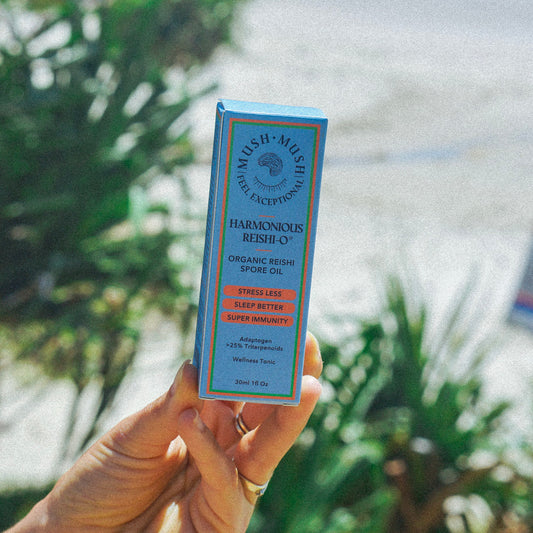
We live in a world that celebrates productivity.
We're encouraged to wake up earlier, work harder, train harder, optimise everything, and somehow still have energy left over at the end of the day.
But there is one thing modern wellness often overlooks:
Recovery.
Because no matter how healthy your diet is, how many supplements you take, or how productive you become, your body still needs time to rest, repair, and restore itself.
This is where Reishi enters the picture.
Known as the "Mushroom of Immortality," Reishi has been used for thousands of years in traditional wellness systems to support vitality, resilience, and longevity. Today, researchers are studying it for many of the same reasons, particularly its relationship with stress, sleep, nervous system balance, and recovery. [1]
Unlike mushrooms associated with energy and focus, Reishi is often described as the mushroom of restoration.
And in today's always-on world, that might be exactly what many of us need.
What is Reishi?
Reishi, or Ganoderma lucidum, is a medicinal mushroom that grows on hardwood trees throughout Asia and other parts of the world.
It has been used in traditional Chinese medicine for more than 2,000 years and was historically considered so valuable that it was often reserved for royalty and nobility.
Modern analysis has revealed that Reishi contains a range of bioactive compounds, including:
Beta-glucans
Triterpenes
Polysaccharides
Peptidoglycans
These compounds are thought to contribute to many of Reishi's observed wellness-supporting effects. [2]

What does rejuvenation actually mean?
The word rejuvenation gets thrown around a lot in the wellness industry.
But biologically, rejuvenation is not about feeling younger overnight.
It is about creating the conditions that allow the body to recover efficiently.
Every day your body is constantly repairing tissue, regulating hormones, balancing immune activity, managing stress responses, and restoring energy reserves.
When recovery cannot keep up with demand, people often experience:
Persistent fatigue
Poor sleep quality
Reduced stress tolerance
Brain fog
Lower motivation
Feeling "flat" despite doing all the right things
True rejuvenation happens when the body has the resources and environment it needs to restore balance.
How does stress affect recovery?
One of the biggest obstacles to rejuvenation is chronic stress.
Stress is not inherently bad. In fact, short-term stress helps us adapt and perform.
The problem arises when the body remains in a heightened state for extended periods.
When stress becomes chronic, the nervous system spends more time in sympathetic mode, often called the "fight or flight" response.
This state prioritises immediate survival over recovery.
Sleep quality may suffer.
Digestion may become less efficient.
Energy reserves may become depleted.
Over time, the body finds it increasingly difficult to restore itself effectively. [3]

Is Reishi an adaptogen?
Yes.
Reishi is commonly classified as an adaptogen, a category of herbs and mushrooms that help the body adapt to physical, emotional, and environmental stressors.
Adaptogens are unique because they do not force the body in one direction.
They do not stimulate like caffeine.
They do not sedate like sleeping tablets.
Instead, they help support balance.
Researchers believe adaptogens work by interacting with systems involved in stress regulation and homeostasis, the body's natural tendency toward equilibrium. [4]
This is one reason Reishi has become so popular among people looking for a more sustainable approach to wellbeing.
How does Reishi support the nervous system?
One of the most fascinating areas of Reishi research involves its relationship with the nervous system.
Reishi has been studied for its ability to support parasympathetic nervous system activity, often referred to as the "rest and restore" branch of the nervous system. [5]
The parasympathetic nervous system is responsible for:
Recovery
Repair
Digestion
Relaxation
Energy conservation
In modern life, many people spend the majority of their time in a state of low-level sympathetic activation.
Emails.
Deadlines.
Notifications.
Traffic.
Financial pressures.
Even when the threat is psychological rather than physical, the body often responds in similar ways.
Supporting parasympathetic activity may help create an internal environment more conducive to recovery.

Can Reishi help with sleep?
This is one of the most frequently searched questions about Reishi.
Research suggests Reishi may support sleep quality through its influence on stress pathways and nervous system regulation rather than through direct sedation. [6]
Many people report feeling calmer, more grounded, and better able to unwind when incorporating Reishi into their evening routine.
Importantly, Reishi is not generally used as a sleeping pill.
Instead, it appears to support some of the underlying systems that contribute to restorative sleep.
And restorative sleep is one of the most powerful rejuvenation tools available.
Why recovery is becoming the new productivity hack
There is an interesting shift happening in the wellness world.
For years, the focus was on doing more.
Now, many people are realising that sustainable performance depends on recovering better.
Athletes understand this.
High performers understand this.
The body improves during recovery, not during stress itself.
This is why practices like sleep optimisation, meditation, breathwork, and nervous system regulation have become increasingly popular.
Reishi fits naturally into this conversation.
Not because it forces results.
But because it supports the systems responsible for creating them.
The bottom line
Reishi is not a quick fix.
It is not a stimulant.
It is not designed to provide an immediate rush of energy.
Instead, Reishi supports something far more valuable.
The body's ability to recover.
Through its effects on stress resilience, nervous system balance, and restorative processes, Reishi offers a different approach to wellbeing.
One based on restoration rather than stimulation.
Because sometimes feeling your best starts not with pushing harder, but with recovering more effectively.
References
[1] International Journal of Medicinal Mushrooms – Traditional Uses of Ganoderma lucidum
https://www.dl.begellhouse.com/journals/708ae68d64b17c52.html
[2] Molecules – Ganoderma lucidum Bioactive Compounds and Health Effects
https://www.mdpi.com/1420-3049/24/18/3369
[3] Frontiers in Psychology – Chronic Stress and Physiological Recovery
https://www.frontiersin.org/articles/10.3389/fpsyg.2017.02086/full
[4] Pharmacological Reviews – Adaptogens in Stress Protection
https://pharmrev.aspetjournals.org/content/70/2/224
[5] Evidence-Based Complementary and Alternative Medicine – Reishi and Nervous System Regulation
https://www.hindawi.com/journals/ecam/2019/2439560/
[6] Frontiers in Pharmacology – Ganoderma lucidum and Sleep Support Research
https://www.frontiersin.org/articles/10.3389/fphar.2021.698038/full