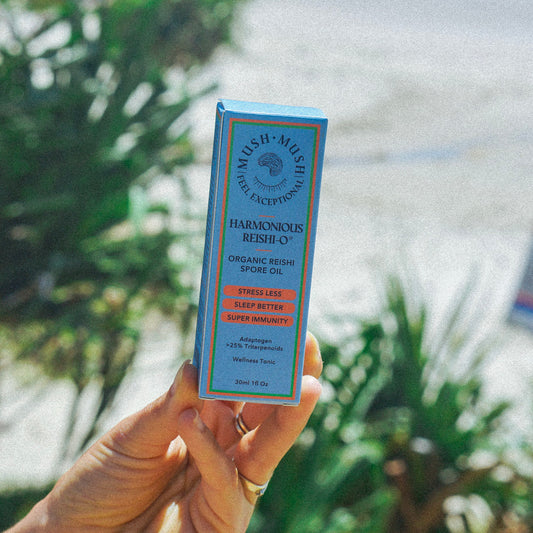
Reishi mushroom (Ganoderma lucidum), also called Lingzhi, has been used for centuries in Chinese medicine as a calming tonic. Today, it is one of the most popular functional mushrooms for people struggling with sleep issues. But how exactly does Reishi help with sleep, and what does the science say?
What Compounds in Reishi Support Sleep?
Reishi is rich in triterpenes and polysaccharides, two groups of compounds that play a key role in its calming effects. Triterpenes have been shown to interact with the central nervous system, promoting relaxation and reducing overactivity of the stress response. Polysaccharides, on the other hand, support immune health and help regulate inflammation, which can indirectly improve sleep quality (Wang et al., 2017).

Does Reishi Calm the Nervous System?
Yes. Reishi acts as an adaptogen, meaning it helps the body adapt to physical and emotional stress. Studies suggest Reishi supports the hypothalamic-pituitary-adrenal (HPA) axis, which regulates cortisol — the stress hormone. By helping balance cortisol rhythms, Reishi reduces feelings of anxiety and restlessness, both of which are major barriers to falling asleep (Sanodiya et al., 2009).
Can Reishi Improve Sleep Quality?
Animal and human studies indicate that Reishi can lengthen total sleep time and improve non-REM sleep stages. One study found that Reishi extracts increased sleep duration and non-REM sleep in mice without causing dependency or morning grogginess (Wachtel-Galor et al., 2004). Unlike pharmaceutical sleep aids, which often disrupt natural cycles, Reishi appears to work with the body to support deeper, more restorative sleep.
Does Reishi Reduce Night-Time Wakings?
Poor sleep often comes from difficulty staying asleep rather than falling asleep. By calming the nervous system and lowering inflammation, Reishi helps reduce middle-of-the-night wakings. This is one of the reasons people using Reishi often report waking up feeling more refreshed, even if their total sleep time is not dramatically longer.

How Should You Take Reishi for Sleep?
Reishi is naturally bitter, so most people prefer it as a powder, extract, or oil rather than drinking it as a plain tea. Evening use is most common, often about an hour before bed, as part of a calming routine. At Mush Mush, our Harmonious Reishi-O is a spore oil rich in triterpenes, specifically formulated for relaxation and immune balance. Consistency is key — most studies show that Reishi works best when taken daily for at least several weeks (Bishop et al., 2015).
In Summary
Reishi helps with sleep by calming the nervous system, balancing cortisol, reducing inflammation, and promoting deeper sleep cycles. Unlike quick fixes that leave you groggy, Reishi supports long-term sleep quality in a natural way. If you’re looking for a gentle and effective way to wind down at night, Reishi is one of the most researched and reliable functional mushrooms to start with.
References
-
Wang, X., Zhang, Y., Li, Y., Yang, X., & Wang, L. (2017). A review of the medicinal uses, pharmacology, and toxicology of Ganoderma lucidum. Mycology, 8(2), 121–131. Link
-
Sanodiya, B. S., Thakur, G. S., Baghel, R. K., Prasad, G. B., & Bisen, P. S. (2009). Ganoderma lucidum: a potent pharmacological macrofungus. Current Pharmaceutical Biotechnology, 10(8), 717–742. Link
-
Wachtel-Galor, S., Yuen, J., Buswell, J. A., & Benzie, I. F. (2004). Ganoderma lucidum (Lingzhi or Reishi): A medicinal mushroom. Herbal Medicine: Biomolecular and Clinical Aspects. Link
-
Bishop, K. S., Kao, C. H., Xu, Y., Glucina, M. P., Paterson, R. R., & Ferguson, L. R. (2015). From 2000 years of Ganoderma lucidum to recent developments in nutraceuticals. Phytochemistry, 114, 56–65. Link
-
Gao, Y., Zhou, S., Huang, M., & Xu, A. (2002). Anticancer and immunomodulating polysaccharides from Ganoderma lucidum. Planta Medica, 68(11), 971–975. Link