Feeling productive isn’t just about having more energy.
You can drink another coffee and feel more awake, but that doesn’t necessarily mean you’ll be more focused, think more clearly or get more done. In fact, for some people, piling on more caffeine can have the opposite effect — leaving them wired, distracted or heading towards an afternoon crash.
This is one reason functional mushrooms such as Lion’s Mane and Cordyceps have become increasingly popular for people looking to support focus, energy and day-to-day productivity.
But what do these mushrooms actually do? And is there any evidence behind the hype?
Let’s break it down.

Can functional mushrooms help with productivity?
Functional mushrooms aren't stimulants in the same way caffeine is.
Instead, different mushroom species contain naturally occurring compounds that are being studied for their potential effects on areas including cognitive function, fatigue, exercise performance, stress and general wellbeing.
When we talk about mushrooms and productivity, two stand out in particular:
-
Lion’s Mane — primarily associated with cognitive function, memory and focus.
-
Cordyceps — primarily associated with energy metabolism, fatigue and physical performance.
That makes them an interesting combination for productivity because productivity depends on more than simply feeling awake.
You need enough energy to keep going, but also enough mental clarity to direct that energy towards something useful.

Lion’s Mane: the mushroom most associated with focus
Lion’s Mane (Hericium erinaceus) is one of the most widely discussed functional mushrooms for brain health.
It contains naturally occurring compounds including hericenones and erinacines, which have attracted scientific interest because of their potential relationship with nerve growth factor (NGF) and neurological function.
Human research is still developing, so Lion’s Mane shouldn't be treated as a quick cognitive stimulant or a guaranteed way to improve concentration.
However, several studies have investigated its potential effects on areas such as cognitive function, memory, mood and stress.
Does Lion’s Mane give you energy?
Not in the way coffee does.
Lion’s Mane doesn't naturally contain caffeine, and you shouldn't expect to drink it and suddenly feel a stimulant-like surge of energy.
Its appeal for productivity is more closely connected with cognitive support than stimulation.
This is an important distinction.
If caffeine is about making you feel more awake, Lion’s Mane is generally used by people looking to support the thinking side of productivity — focus, mental clarity and cognitive performance.
Cordyceps: the mushroom associated with energy
If Lion’s Mane is the mushroom most closely associated with the brain, Cordyceps is usually the mushroom associated with energy and performance.
Cordyceps has traditionally been used in Chinese medicine and is now widely studied in relation to exercise performance, fatigue and cellular energy production.
One area of particular interest is ATP — adenosine triphosphate.
ATP is essentially the energy currency used by our cells. Research into Cordyceps has explored whether compounds within the mushroom may influence the body's production or utilisation of ATP, although the evidence in humans remains mixed.
Does Cordyceps contain caffeine?
No.
Cordyceps does not naturally contain caffeine.
That means any energising effects associated with Cordyceps work very differently from drinking coffee or an energy drink.
Rather than directly stimulating the central nervous system with caffeine, Cordyceps is generally used to support energy, stamina and physical performance.

Lion’s Mane vs Cordyceps for productivity
There isn't necessarily a winner because they are used for different purposes.
Lion’s Mane is primarily used for cognitive support, while Cordyceps is primarily used for energy and performance support.
For someone interested specifically in productivity, this is why the two mushrooms are often paired together.
Lion’s Mane addresses the cognitive side of the equation.
Cordyceps addresses the energy side.
And that combination is particularly relevant when the goal isn't simply to feel more stimulated, but to maintain useful energy and focus throughout the day.
Why caffeine can help productivity — until it doesn't
Caffeine absolutely can improve alertness, attention and reaction time.
The problem isn't necessarily coffee itself. It's how much caffeine we consume and when we consume it.
A morning coffee might be enough to get going. Then comes another at 10am. Another after lunch. Maybe an energy drink when the afternoon slump arrives.
More stimulation doesn't always equal more productivity.
Higher caffeine intake can cause unwanted effects in some people, including restlessness, nervousness, increased heart rate and disrupted sleep.
And sleep matters enormously for productivity.
If the caffeine you use to stay productive today interferes with tonight's sleep, you may wake up tomorrow needing even more caffeine to compensate.
That's not a particularly useful cycle.

Can you combine functional mushrooms with coffee?
Yes.
Functional mushroom extracts can be combined with coffee, which is why mushroom coffee has become such a popular way of consuming Lion’s Mane and Cordyceps.
The important thing to understand is that the mushrooms aren't replacing coffee chemically.
They're doing something different.
Coffee provides caffeine and its associated stimulant effects, while functional mushrooms provide their own naturally occurring bioactive compounds.
This creates an interesting approach to productivity: moderate stimulation combined with ingredients selected for cognitive and energy support.
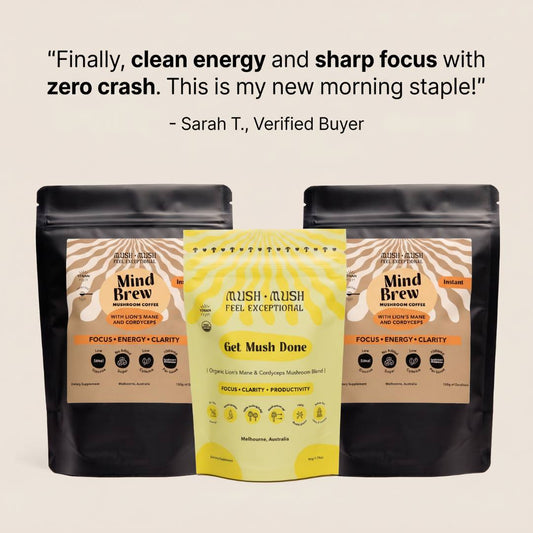
That's also the thinking behind our Mind Brew formula at Mush Mush.
Rather than trying to create the strongest coffee possible, Mind Brew combines Arabica coffee with Lion’s Mane, Cordyceps, MCT and L-theanine.
The goal is fairly simple: keep the familiar coffee ritual while taking a more considered approach to energy and focus.
What is L-theanine doing in a productivity drink?
L-theanine isn't a mushroom. It's an amino acid naturally found in tea.
It has become particularly interesting in productivity formulas because of its relationship with caffeine.
Research has investigated caffeine and L-theanine together for their potential effects on attention and cognitive performance.
Rather than simply adding more caffeine, pairing caffeine with L-theanine is one way formulations can take a more balanced approach to stimulation.
This is one of the reasons you'll increasingly see L-theanine alongside coffee, tea and functional mushrooms in products designed around focus.

What about MCT?
MCT stands for medium-chain triglycerides.
These fats are metabolised differently from many longer-chain dietary fats and can be converted relatively quickly into a usable source of energy.
MCT isn't a stimulant and doesn't provide the immediate alertness associated with caffeine.
Instead, it's another ingredient commonly used in products designed around sustained energy and performance.
So when you look at a formula combining coffee, Lion’s Mane, Cordyceps, L-theanine and MCT, each ingredient has a different job.
Coffee provides caffeine.
Lion’s Mane is included for cognitive support.
Cordyceps is included for energy and performance support.
L-theanine complements the caffeine component.
MCT provides an additional nutritional energy source.
Do functional mushrooms work immediately?
Usually, functional mushrooms shouldn't be thought about like caffeine.
Caffeine can produce noticeable effects relatively quickly because it's a stimulant.
Functional mushrooms aren't stimulants, and research into mushrooms such as Lion’s Mane typically investigates consumption over a period of days or weeks rather than treating them as an instant performance enhancer.
That means taking Lion’s Mane once before an important meeting and expecting an immediate surge of concentration probably isn't the best way to think about it.
Consistency is generally more relevant.
When is the best time to take Lion’s Mane and Cordyceps?
There's no universally established “best” time.
However, because Lion’s Mane and Cordyceps are commonly used to support cognitive performance, energy and activity, many people choose to take them earlier in the day.
They can be incorporated into coffee, tea, smoothies or other drinks depending on the format.
The bigger consideration is often what they're combined with.
A mushroom extract itself may contain no caffeine, while a mushroom coffee obviously does. If you're sensitive to caffeine or trying to protect your sleep, the caffeine content of the entire product matters.

What should you look for in a functional mushroom product?
Not all mushroom products are made in the same way.
If you're choosing functional mushrooms for focus or energy, look beyond the mushroom name on the front of the packet.
Some useful things to check include:
The part of the mushroom used.
Products may use fruiting bodies, mycelium or combinations of both.
Whether it's an extract.
Extraction is commonly used to make important mushroom compounds more accessible.
Beta-glucan content.
Beta-glucans are among the major bioactive compounds found in functional mushrooms. A clearly stated beta-glucan percentage can tell you more than a vague claim about “mushroom polysaccharides”.
The actual dose.
A product containing Lion’s Mane isn't necessarily providing a meaningful amount of it. Check how much mushroom extract you're actually getting per serve.
Testing and transparency.
Look for brands that provide clear information about sourcing, extraction and quality testing.
At Mush Mush, for example, we use fruiting-body mushroom extracts with a standardised beta-glucan content rather than adding a token amount of mushroom powder simply to put “mushroom coffee” on the packet.
So, which mushroom is best for energy and productivity?
If your priority is focus and cognitive performance, Lion’s Mane is the obvious mushroom to investigate.
If your priority is energy, stamina and physical performance, Cordyceps is the more relevant choice.
If you're interested in overall daytime productivity, combining the two makes sense because they target different parts of the equation.
But functional mushrooms shouldn't be viewed as magic productivity hacks.
Sleep, nutrition, movement, stress and caffeine consumption will have a much bigger influence on how you function from day to day.
Functional mushrooms are better thought of as one part of that bigger picture.
And perhaps that's the more useful way to think about productivity in general.
The goal isn't to feel more stimulated.
It's to have enough energy, clarity and focus to actually do what you need to do.

Frequently Asked Questions
What mushroom is best for productivity?
Lion’s Mane is one of the functional mushrooms most commonly associated with cognitive function, focus and memory. Cordyceps is more commonly associated with energy, stamina and physical performance. They are frequently combined in products designed for daytime productivity.
What mushroom gives you the most energy?
Cordyceps is the functional mushroom most commonly associated with energy and physical performance. It doesn't contain caffeine and isn't a stimulant, so its potential effects are different from those of coffee or energy drinks.
Does Lion’s Mane give you energy?
Lion’s Mane isn't a stimulant and doesn't naturally contain caffeine. It is primarily researched for its potential relationship with cognitive and neurological function rather than providing an immediate energy boost.
Can you take Lion’s Mane and Cordyceps together?
Yes. Lion’s Mane and Cordyceps are commonly consumed together because they have different areas of interest: Lion’s Mane for cognitive support and Cordyceps for energy and performance.
Can you put functional mushrooms in coffee?
Yes. Extracted functional mushrooms can be combined with coffee. Mushroom coffee generally combines the stimulant effects of caffeine with functional mushroom extracts such as Lion’s Mane or Cordyceps.
Is mushroom coffee better for productivity than regular coffee?
It depends on the formula. Regular coffee primarily provides caffeine, while mushroom coffee can combine caffeine with functional ingredients such as Lion’s Mane, Cordyceps or L-theanine. The amount and quality of each ingredient matter more than simply having “mushroom coffee” written on the label.
Do functional mushrooms contain caffeine?
Functional mushrooms including Lion’s Mane and Cordyceps don't naturally contain caffeine. However, mushroom coffee products may contain caffeine because they also contain coffee. Always check the caffeine content of the finished product.
References:
-
Mori K, et al. (2009). Improving effects of the mushroom Yamabushitake (Hericium erinaceus) on mild cognitive impairment: a double-blind placebo-controlled clinical trial. Phytotherapy Research, 23(3), 367–372.
View study on PubMed
This is a useful foundational Lion's Mane study. Participants taking Lion's Mane showed improvements on a cognitive-function scale during the 16-week intervention, although the study was small. -
Saitsu Y, et al. (2019). Improvement of cognitive functions by oral intake of Hericium erinaceus. Biomedical Research.
View study on PubMed
Useful additional human evidence examining Lion's Mane and cognitive function. -
Docherty S, et al. (2023). The Acute and Chronic Effects of Lion's Mane Mushroom Supplementation on Cognitive Function, Stress and Mood in Young Adults. Nutrients.
Read the full study via PubMed Central
Particularly relevant to our article because it studied healthy young adults. Results tentatively suggested improvements in speed of performance and subjective stress, but the researchers emphasised the small sample size and need for more research. -
Chen S, et al. (2010). Effect of Cs-4® (Cordyceps sinensis) on Exercise Performance in Healthy Older Subjects. Journal of Alternative and Complementary Medicine.
Read the full Cordyceps study
A small human study investigating Cordyceps supplementation and exercise performance. -
Hirsch KR, et al. (2017). Cordyceps militaris improves tolerance to high intensity exercise after acute and chronic supplementation. Journal of Dietary Supplements.
Read the full study via PubMed Central
Relevant to our discussion around Cordyceps, energy and physical performance. The study found improvements in some exercise-performance measures after continued supplementation, although this was a mushroom blend rather than isolated Cordyceps. -
Sohail AA, et al. (2021). The Cognitive-Enhancing Outcomes of Caffeine and L-theanine: A Systematic Review. Cureus.
Read the systematic review
This is particularly useful for the Mind Brew section. The review examined clinical trials involving caffeine, L-theanine and their combination, including outcomes relating to attention, cognition and mood. -
Baba Y, et al. (2021). Effects of L-Theanine on Cognitive Function in Middle-Aged and Older Subjects. Journal of Medicinal Food.
Read the full study
Provides further human research into L-theanine, attention, working memory and executive function. -
Drake C, et al. (2013). Caffeine Effects on Sleep Taken 0, 3, or 6 Hours before Going to Bed. Journal of Clinical Sleep Medicine.
Read the full caffeine and sleep study
Useful evidence for the section discussing the relationship between caffeine, sleep and next-day productivity. The study found substantial caffeine intake could disrupt sleep even when consumed six hours before bedtime.